Charon: AI software that takes stock from pallet to finished listing
A custom WMS/ERP-class system for one-person reselling — from the pallet manifest to a live listing.
AI-driven pricing, sales copy and cataloguing.
What Charon is
Charon is a complete platform for reselling stock from liquidation pallets — consumer returns from the UK market. Instead of juggling spreadsheets, photo folders and hand-written listings, the whole process happens in one mobile tool: pallet profitability analysis, intake, cataloguing, and publishing to Vinted, OLX, Allegro and Facebook.
At its core sits AI (Google Gemini) that prices the stock, generates sales copy and helps decide which pallet is worth buying in the first place. Built entirely solo, it runs on free infrastructure and replaces a stack of paid, scattered tools.
What it looks like inside
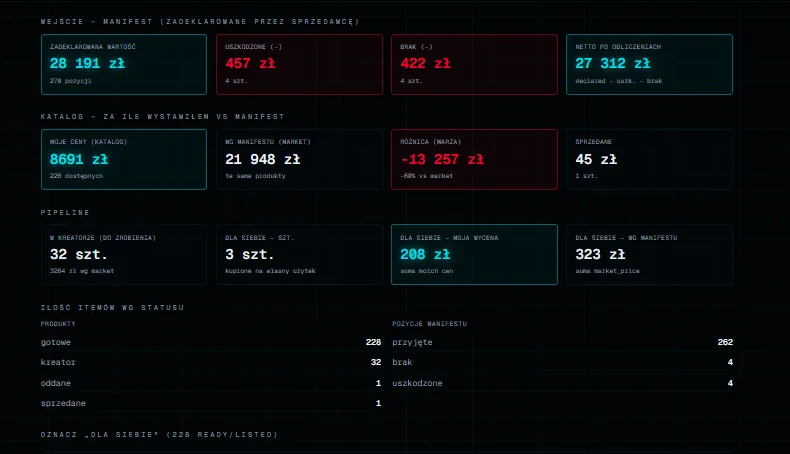
Screens from the running system, nothing staged.


The problem it solves
Pallet return trading is a business where margin is made at two moments: buying the right pallet, and listing every single item quickly and cheaply. Off-the-shelf systems handle neither well for a solo operator.
Marketplace integrators
Tools like BaseLinker sync listings beautifully, but assume you already have a described, priced product. They neither help you decide what to buy nor write the content.
WMS/ERP systems
Expensive, heavy and designed for warehouses with a team, not for one person with a phone and a pallet in the garage.
The manual workflow
Excel, Google Drive and copy-pasted descriptions are free, but slow, and they do not scale across hundreds of varied one-off products.
Charon exists to merge those three worlds into a single flow tailored to this exact niche, cutting the time between the pallet arriving and everything being listed.
What it does — the full flow
01Pallet profitability analysis
You upload the carrier manifest (PDF or XLSX, in Jobalots, Kaufnet and generic formats). AI parses the line items, estimates resale value and sell-through and factors in seasonality — telling you whether the pallet is worth it before you buy.
02Stock intake
Mobile-first. You check physical goods against the manifest straight from your phone, take photos and flag missing or damaged items.
03AI listing builder
For each item, AI generates a title, a description written as a private seller rather than corporate filler, tags and a category. It picks manufacturer images alongside your own and proposes three price tiers — quick, recommended and maximum — anchored to the market price.
04Public catalogue
Finished products land in a customer-facing browser: parent categories, filters by tag and by sales channel, swipeable photo galleries, and an Amazon link as proof of real-world value.
05Fast publishing
One-click export of the photo bundle and description, bulk repricing, and management of listing links across every platform.
06Operational reports
Intake value versus your prices, how much sits in the queue, what is flagged for review, what is set aside for personal use, and status counters.
How it competes with paid systems
It does what the paid ones do not
Pre-purchase AI pallet profitability scoring and automatic sales-copy generation. Elsewhere those are two separate manual stages, or two separate paid tools.
One flow instead of five tools
It replaces the combination of a spreadsheet, a photo drive, manual copywriting and a marketplace integrator.
Near-zero running cost
It runs on free tiers (Vercel and Supabase, with AI billed per use), while commercial systems carry a fixed monthly subscription.
Tailored, not generic
Every screen is designed for one specific business — one-off pallet returns — so there is no incidental complexity built for everyone else.
Mobile by design
The entire intake and cataloguing process works from a phone next to the pallet, with no warehouse workstation required.
Tech stack
Next.js 16 (App Router) · TypeScript · Tailwind CSS v4 · shadcn/ui · Supabase (PostgreSQL + Storage) · Google Gemini via the Vercel AI SDK · Vercel
The more interesting engineering problems
Processing inside a 60-second budget
Multi-stage, incremental manifest scoring with concurrency control, so the serverless function limit is never exceeded.
The manifest parser
Handling different carrier formats across both PDF and XLSX, with header autodetection.
Advanced catalogue UX
Infinite scroll with scroll-position restoration on back-navigation, gesture-driven galleries, and server-side photo bundle generation that sidesteps CORS restrictions.
Schema-change resilience
The write layer silently skips missing columns, so the UI keeps working before the database migration lands.