Quantum OM: a team of AI agents that makes market decisions on its own
A Multi-Agent AI ecosystem designed for instant crypto asset analysis.
Decisions built on fast consensus and advanced logical safeguards.
Real capital on a real exchange
This was not a simulator. The agents were wired to a Binance Spot account, had their own budget and full autonomy to spend it — they bought and sold without asking me first.
The bot was given 65 USDC (roughly £50) and a watchlist of five assets: BTC, WIF, PEPE, FET and SEI. Every fifteen minutes it woke up, gathered market data, ran it past the analyst panel and either did nothing or placed a real order on the exchange. Across a single budget cycle it made over a thousand such decisions.
The amount was small on purpose. The point was to make the feedback loop real — real prices, real slippage, real fees and a real cost of being wrong — not to earn. A proving ground, not an investment. At that scale an architectural mistake costs a few pounds instead of a few thousand, and teaches exactly the same lesson.
Last cycle parameters
65 USDC
Starting budget
~15 min
Cycle frequency
1000+
Decisions per cycle
5
Assets on the watchlist
22 USDC
Max order size
3
Max open positions
This is a research project: the point was to find out whether a multi-agent architecture holds up against a real market — real prices, real slippage, real fees and a real cost of being wrong. It is not an investment strategy or a financial offer, and I do not publish trading results.
Decision Architecture: Space-grade standards on Earth
The foundation of Quantum OM is a multi-agent consensus structure inspired by flight computer systems used by NASA.
Just like in avionics, the system utilizes three specialized 'Analyst-Agents': Tech Analyst (Momentum), Sentiment Analyst (Vibe/Psychology), Volume Analyst (Liquidity Guard).
The system operates on Fast Path Consensus – actions only fire upon agent quorum, relying on an Orchestrator as the final conflict arbiter.
The analyst panel
Five specialised roles, deliberately split across different models and different cost tiers. Cheap models grind through every cycle; the expensive one only steps in when there is an actual dispute to settle.
ERBSBUNDE
Technical analyst
Reads momentum and price structure. The panel's baseline vote.
Gemini 2.5 Flash Lite
KIWI
Sentiment analyst
Judges market mood and fresh news. Lowest weight, because sentiment lies most often.
Gemini 2.5 Flash Lite
ZEPHYR
Volume analyst
Watches liquidity and volume. Highest weight, because missing liquidity invalidates every other argument.
Gemini 2.5 Flash Lite
SCOUT
Reconnaissance
Scans the whole watchlist and names one asset worth a deeper look. Cuts 80% of the work before it starts.
Claude Haiku 4.5
SEELE
Orchestrator
Settles disagreements between analysts and issues the final verdict with its reasoning.
Claude Sonnet 4.6
One decision cycle
- 01
Reconnaissance
Scout receives a market summary for the whole watchlist and names one asset worth attention. When it fails, it deliberately passes everything through rather than blocking the pipeline.
- 02
Analyst panel
Three analysts vote in parallel: a decision, a confidence percentage and a short justification. The panel has a hard 8.5-second budget — past that the whole panel returns HOLD instead of hanging.
- 03
Fast Path
If all three agree on BUY or SELL and each is over 60% confident, the orchestrator is skipped entirely. Agreement needs no arbiter — and every skipped call saves both latency and money.
- 04
Arbitration
On disagreement the votes go to the orchestrator together with RAG context: the bot's own trade history, news, and the strategist's guidelines. It returns the verdict.
- 05
Guard
The AI verdict is a recommendation, not an order. Before anything reaches the exchange it passes through a deterministic rule layer that can reject or override it.
- 06
Execution and reporting
The approved order goes to Binance Spot, position state lands in the database, and Telegram receives a notification with the decision, the reasoning and the outcome.
Guard — the layer that does not trust the AI
The single most important architectural decision in the project: the language model never has direct access to an order. Between its conclusion and the exchange sits ordinary deterministic code that can be read, tested, and that does not hallucinate.
Stop loss
−3%
Hard close on a losing position, regardless of what the AI thinks.
Take profit
+5%
Forced realisation of gains above the threshold.
Trailing stop
high-water mark
Past the activation threshold the stop follows the peak, but never drops below the entry price.
Minimum hold
20 min
A sell lock right after buying — kills nervous in-and-out churn.
Re-entry cooldown
60 min
No rebuying the same asset, so the bot cannot chase its own tail.
Daily loss limit
2 per asset
After two losing trades on one symbol within a day — pause.
The 'umbrella' doctrine
Capital gating applies to entries only. Exiting a position is never blocked — not by cooldowns, not by capital limits. This came out of a real bug: when cash was tied up in coins, the safeguards could block a sell and trap the bot in a losing position. Since exits always take priority, that deadlock cannot recur.
Memory: a bot that knows how it has been doing
Learning layer
The system pairs historical trades FIFO — each buy with its matching sell — and derives realised P&L and win rate per asset from that. The ledger goes back into the prompt, so the AI decides while knowing how many times it has already been burned on that same symbol.
Cognitive memory
Once a week a separate strategist reviews the last hundred cycles and writes guidelines for the bot's future incarnations. The worker injects them into the prompt as 'a note from yourself, last week'.
Market context
News from an external feed is cached in the database and handed to the analysts as a suggestion, never as a hard rule. Deliberately — a model that treats a headline as an order is trivially easy to manipulate.
Budget cycles
Capital is accounted for in closed periods with their own opening balance, deposits, trade count and API cost. That shows not just the result but what producing it cost.
Command Center and Telegram
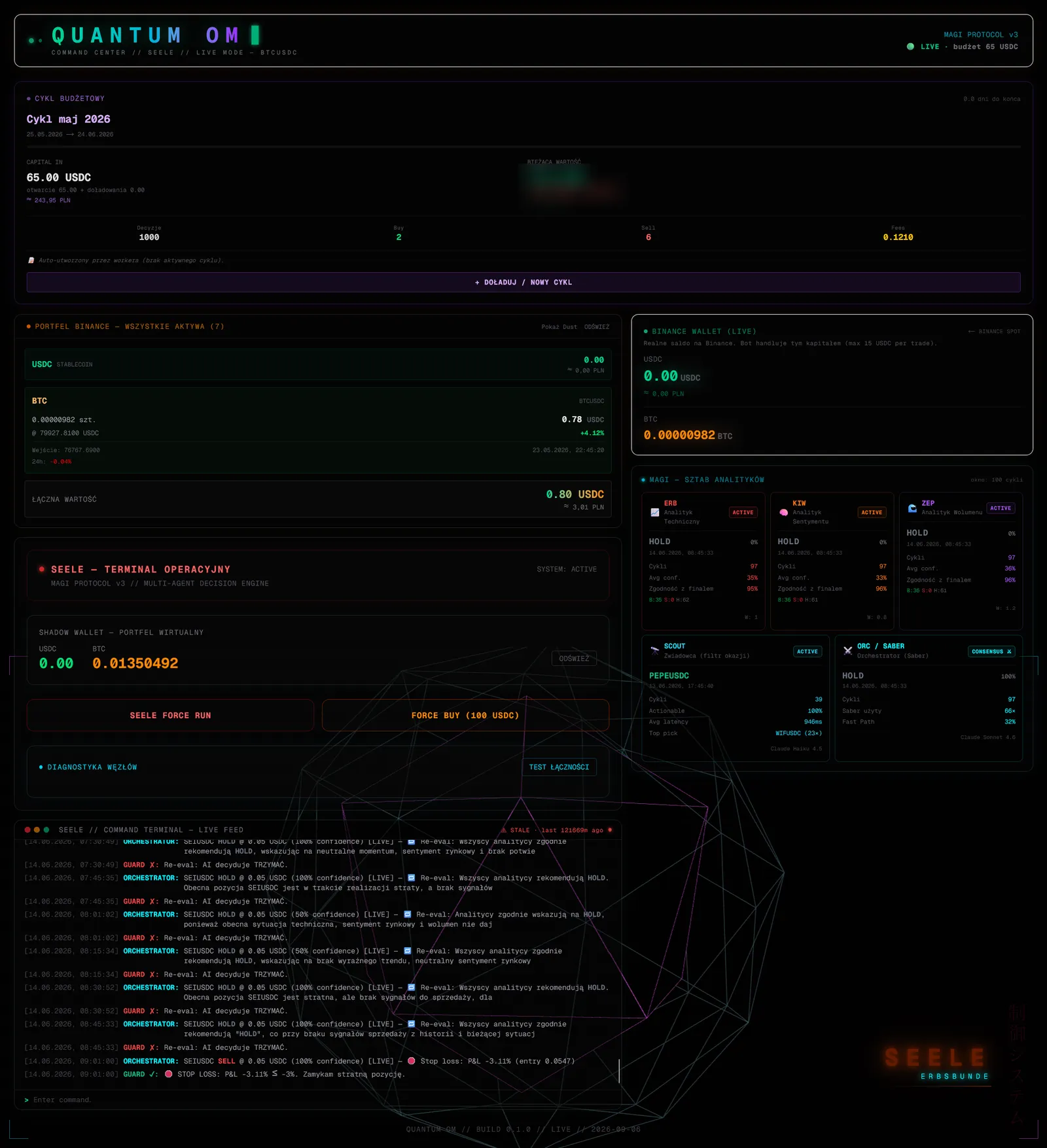
The system got its own command panel — a separate application showing every part of the machine live.
Operational dashboard
The budget cycle with its balance, the portfolio with real Binance holdings, the state of each of the five agents alongside their hit rate and agreement with the final verdict, and a terminal streaming decisions live.
Telegram notifications
Every cycle and every position change lands on Telegram: what the bot did, why, at what price and with what result. The channel was the primary interface — the dashboard was for diagnosis, the phone for day-to-day supervision.
Status without opening anything
Each message header opens with an emoji encoding the last action: a green circle for a buy, fireworks for a profitable sell, red for a loss, yellow for no action. One glance at the notification list tells you what is happening.
Manual controls
The panel could force a cycle, place an order by hand, adopt an existing position, and test connectivity to each node of the system separately.
Applied Technologies & Innovations
Dual-Brain Failover Strategy
The first immune system to dynamically integrate Claude & Gemini. Automatic 'consciousness' switching guarantees 99.9% uptime.
The Guard Pipeline
A safe-mode firewall validating all AI decisions against liquidity and risk rules prior to execution.
RAG Context Injection
Real-time feeding of raw API metrics and DB history directly to the AI to eradicate market hallucinations.
Tech stack
Next.js 16 (App Router) · TypeScript · Supabase (PostgreSQL) · Binance Spot API · Claude Sonnet 4.6 (orchestrator) · Claude Haiku 4.5 (scout) · Gemini 2.5 Flash Lite (analyst panel) · Telegram Bot API · three.js / React Three Fiber · Vercel
Why the project is paused
Binance withdrew from the European market, and that is exactly where the bot traded. Overnight the execution layer lost the exchange it ran on — and that is the only reason the system is standing still. The decision logic, the guard, the memory and the dashboard are untouched and still work.
Migration is not a rewrite
All exchange communication sits in a single adapter module — fetching prices, balances, tickers and placing orders. The rest of the system never talks to Binance directly. Moving to Kraken, Bybit or any other venue means swapping that one file, not renovating the architecture.
The project is for sale
The system is complete and has run thousands of cycles against a live market. You can take over this exact codebase along with its multi-agent architecture, guard layer, memory and dashboard — or commission a fresh build targeting your chosen exchange and your own strategy. The architecture is not tied to crypto either: it is a multi-agent consensus engine with a hard rule layer, and it transfers to other decisions made automatically.
Let's talk about taking it overLegal Disclaimer & Project Nature
This is purely an experimental research initiative forming a Multi-Agent laboratory, not distributed as a commercial or financial service under current regulations.